.jpg)
Worldmed Global: Local Care, Global Confidence
Nepal's Autumn 2026 Tourism Surge — and Why Genuine Medical Assistance Still Matters
Nepal is entering another active tourism season, with growing interest in trekking, adventure, culture, wellness and nature-led travel. From Kathmandu and Pokhara to the Annapurna region and western Nepal, travellers are exploring destinations where extraordinary experiences can also involve remote terrain, changing weather, altitude exposure and limited access to advanced medical facilities.
For travel and health insurers, assistance companies and international travellers, the real question is not simply whether insurance is in place. It is whether a trusted local partner can turn that coverage into fast, clinically appropriate and well-coordinated action when it matters.
Worldmed Global is a Nepal-based medical-services provider and assistance partner, supporting travellers, insurers, TPAs and international assistance companies with 24/7/365 local coordination across Nepal.
Nepal's Tourism Momentum: New Gateways, Wider Reach
The season's growth in traveller interest is being matched by real gains in connectivity. A major development for Nepal's tourism sector arrives on 23 September 2026, when flydubai is scheduled to begin a daily direct Dubai–Pokhara service — the airline's first direct service to Pokhara by a UAE carrier, strengthening Pokhara's connection with Dubai and the wider flydubai/Emirates network. For Gandaki Province, this opens the door to stronger international packages built around Pokhara and the Annapurna region, adventure and trekking, wellness and nature tourism, cultural experiences, luxury and experiential travel, and regional circuits connecting western Nepal.
Domestic connectivity matters just as much for distributing tourism beyond Kathmandu. Buddha Air currently lists Nepalgunj–Pokhara as an operating route, connecting western Nepal's gateway to Pokhara and the Annapurna region and enabling multi-destination itineraries that combine Nepalgunj, Bardiya, Pokhara, Annapurna and Kathmandu.
The opportunity ahead is less about arrival numbers and more about destination value — where visitors go, how long they stay, and how that experience is protected. Nepal can increasingly package Adventure, Wildlife, Wellness, Culture, Pilgrimage, Nature, Community Tourism and Luxury Experiences, with Pokhara serving as a regional hub and western Nepal positioned as a complementary experience rather than a standalone location. Continued instability in West Asia is a reminder, too, that diversifying source markets and strengthening regional connectivity make the whole system more resilient — which makes reliable, locally coordinated medical assistance a growing part of that resilience, not a side note to it.
Why Genuine Assistance Still Matters
A travel-insurance policy can provide essential financial protection. However, a medical emergency in Nepal often requires far more than policy coverage alone.
A traveller with altitude symptoms, a trekking injury, serious illness, flight disruption or a need for urgent transfer may require coordinated clinical assessment, local hospital access, suitable transportation, clear communication and medical oversight. In remote Himalayan locations, a delay or an inappropriate decision can create avoidable risk for both the traveller and the insurer.
The Annapurna Base Camp route, for example, reaches approximately 4,130 metres. Trekkers may face altitude illness, injury on uneven trails, severe weather, landslides and limited medical access. In certain emergencies, helicopter evacuation may be medically necessary, while weather conditions and local operational realities can affect timing and planning.
That is why genuine assistance remains essential: it connects insurance coverage with real-time local action.
How Worldmed Protects Travelers
Worldmed Global supports the full assistance pathway — from the first emergency notification to hospital coordination, transfer, evacuation support and onward travel or repatriation planning.
Clinical Coordination
Our medical-assistance team helps assess the case through appropriate clinical information, including voice or video assessment where feasible. This supports informed decisions around medical necessity, local treatment, patient transfer and evacuation requirements.
Hospital and Provider Navigation
Nepal's healthcare landscape can be complex for international travellers. Worldmed coordinates with a rich local network of hospitals, clinics, ambulance teams, helicopter operators and specialist providers to help identify appropriate options according to the patient's condition and location.
Medical Transport and Evacuation
We coordinate ground ambulance transfers, emergency medical transportation, helicopter evacuation requirements and medically appropriate onward journeys. For high-altitude trekking emergencies, evacuation may be vital when descent on foot or local treatment is not clinically safe.
Cost Control and Transparency
For insurers and TPAs, Worldmed supports treatment review, provider coordination, price estimates, medical-necessity review and practical cost management. Our approach is designed to improve clinical visibility while helping reduce avoidable expenditure and billing uncertainty.
Continuous Local Support
Medical emergencies do not follow office hours. Worldmed's multidisciplinary operation remains available 24/7/365 to support complex cases across Nepal, including Kathmandu, Pokhara, Gandaki Province, and tourism regions nationwide.
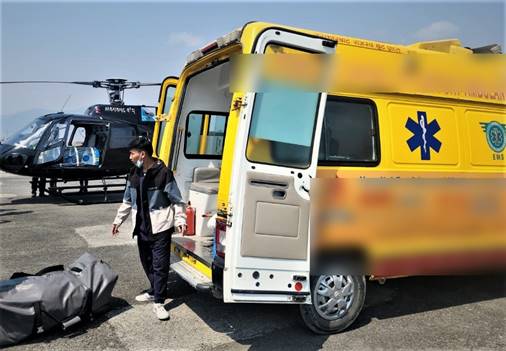
Ground and air coordination in action — an Advanced Cardiac Life Support ambulance and helicopter standing by for a medical transfer.
Insurance Works Best with Assistance
Travel insurance for Nepal should be considered alongside a genuine medical-assistance solution — particularly for trekking, high-altitude activity, remote travel and adventure itineraries. A well-designed policy should address:
- Emergency medical treatment
- Medical evacuation and helicopter rescue where relevant
- High-altitude trekking coverage
- Hospital admission and transfer support
- Trip interruption, delay and cancellation
- Lost, delayed or damaged baggage and essential equipment
- Assistance access when the traveller is remote or unable to navigate the local system independently
A Trusted Nepal Partner
Worldmed Global serves as a local medical-services provider and assistance partner for travel and health-insurance stakeholders, including insurance partners connected with IMG (International Medical Group) and Global Rescue.
Our operational model combines:
- Local medical knowledge
- Clinical coordination
- Hospital and provider access
- Emergency transport planning
- Evacuation and repatriation coordination
- Cost-awareness and reporting support
- Clear communication for insurers, TPAs, assistance companies and travellers
As a member of the United Nations Global Compact and the Jiang Tai Global Alliance, Worldmed Global is committed to responsible, collaborative and human-centred service delivery. Our focus remains practical: ensuring that travellers receive appropriate support while insurance partners gain reliable local coordination, clinical visibility and operational confidence.
Worldmed Global in Nepal
|
Kathmandu Headquarters Nationwide medical assistance and healthcare-provider coordination 24/7 Hotline: +977 9818715468 / +977 9705427741 WhatsApp: +977 9851248606 |
Worldmed Pokhara Center Lakeside, Pokhara Coverage across Gandaki Province and surrounding tourism regions 24/7 Hotline: +977 9801985761 |
Connect with Worldmed
Emergency Medical Services, HEMS, and Assistance: assist@worldmedglobal.com
.png)
.png)